Modular work desk
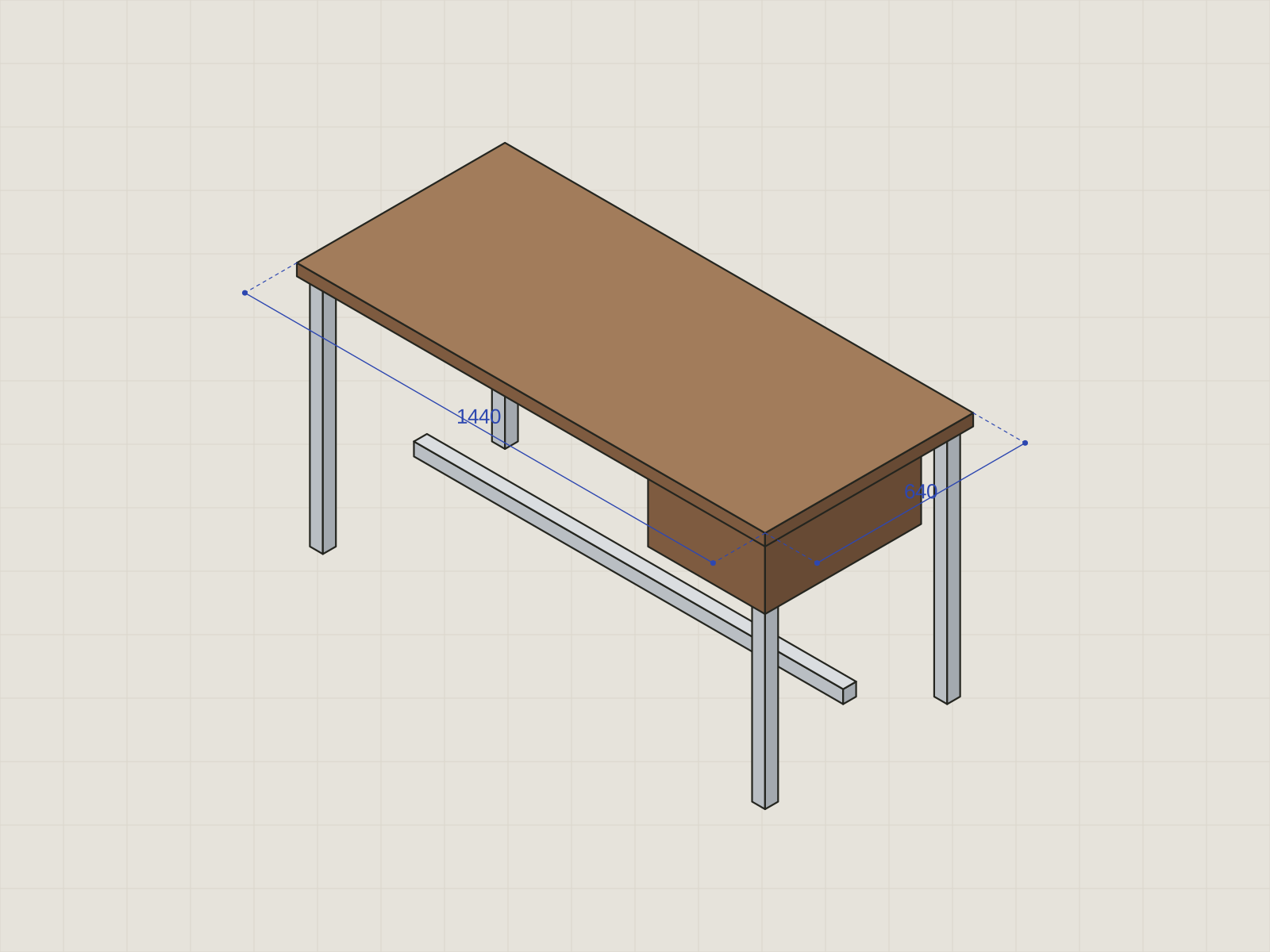
A desk that flat-packs, assembles with one tool, and grows with a drawer module — designed so every part can be cut on a laser or CNC router.
- Year
- 2026
- Type
- Studio product
- Materials
- Walnut veneer plywood, powder-coated steel
- Processes
- CNC routing, laser cutting, press-brake folding
The problem
Most desks we were asked to make were either heavy welded frames that could not fit through a stairwell, or flat-pack desks that wobbled within months.
The brief we set ourselves: a desk that could be carried up four flights by one person per part, assembled in under thirty minutes, and stay rigid for years.
Inspiration and concept
We looked at shelving systems and machine frames rather than other desks. Both get rigidity from folded sheet steel rather than heavy sections.
The first concept used a single folded beam running under the top, with legs bolted to its ends.
Sketches, prototypes and iterations
The first prototype racked side to side under load. Adding a second beam fixed that but doubled the steel cost.
The third version moved the beam lower and turned it into a footrest. The triangle between beam, leg and top gives the stiffness, and the part count dropped by four.
Engineering and manufacturing decisions
- Legs are folded from 1.5 mm steel into a closed C-section, stiff enough without welding.
- All holes are laser cut with the parts, so alignment does not depend on drilling by hand.
- Threaded inserts in the top mean it can be assembled and taken apart many times without wear.
Materials, processes and assembly
18 mm walnut veneer plywood for the top, finished with hardwax oil. Steel is powder coated. Fasteners are M6 stainless button heads, all the same size, so one hex key does everything.
The result
The production desk ships in three boxes, assembles in about twenty minutes and has passed a 100 kg distributed load test with no measurable racking.
Challenges and lessons
Our first prototype tested well on a level studio floor and wobbled on a real apartment floor. Every desk now ships with adjustable feet.
We would also design the drawer module first next time. Retro-fitting it changed the top's hole pattern twice.